




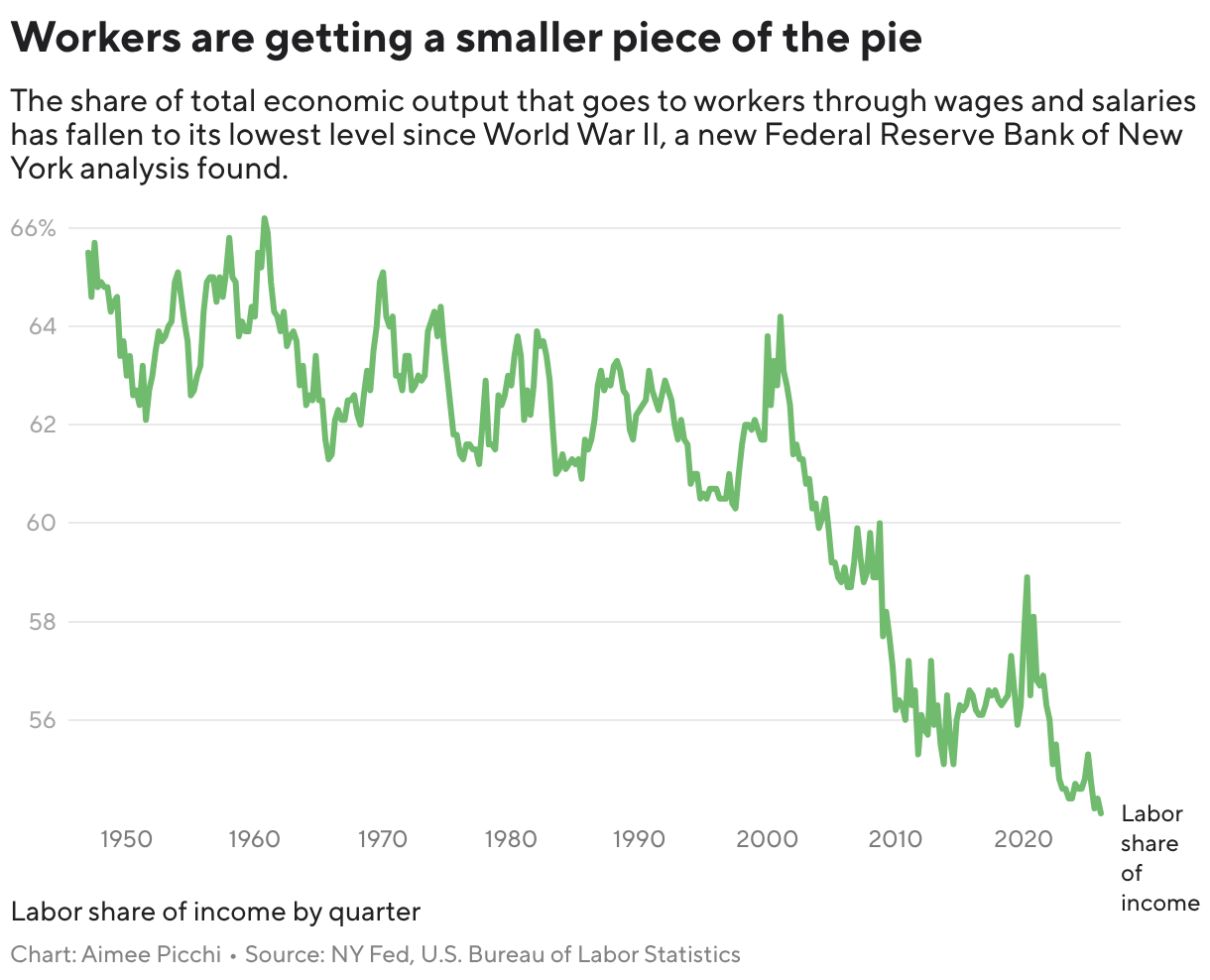
American employees’ share of the financial pie has fallen to its lowest degree since not less than 1947, when the federal authorities started monitoring the information, in keeping with an evaluation by Federal Reserve economists.
The measure, generally known as “labor share of earnings,” tracks how a lot of the nation’s financial output flows to employees within the type of wages and salaries, versus the share that goes to buyers and companies by means of earnings, dividends and different capital earnings. A shrinking labor share of earnings signifies that extra financial beneficial properties are flowing to shareholders and enterprise homeowners, somewhat than to employees.
As of early 2026, American employees obtained 54.1% of nationwide earnings, in keeping with analysis from the Federal Reserve Financial institution of New York. By comparability, that determine topped 65% nearly 80 years in the past, when the federal government started monitoring the information following World Battle II. In early 2020, it stood at 57.7%, indicating that employees have continued to lose floor because the pandemic.
Roughly 48% of Individuals mentioned their monetary scenario was worse in Could than a yr in the past, the very best share since January 2023, in keeping with a current survey by the Federal Reserve Financial institution of New York.
Three-quarters of Individuals mentioned their incomes aren’t maintaining with inflation, in keeping with a Could CBS Information ballot. Roughly 29% of respondents mentioned the economic system was in good condition.
American employees are taking dwelling a smaller share of the nation’s earnings — capturing much less of what the economic system produces — on account of a number of long-standing points, starting from the erosion of union membership to tax legislation adjustments which have steered extra beneficial properties to CEOs, buyers and high-income Individuals, economists instructed CBS Information.
As these currents performed out over many years, many low- and middle-income employees have misplaced financial floor, making them really feel more and more financially precarious even because the economic system as a complete has continued to develop and rebound within the wake of a number of crises.
“You have obtained lots of people who appear to work for corporations that, within the mixture, appear to be doing rather well,” mentioned Josh Bivens, chief economist on the Financial Coverage Institute, a nonpartisan suppose tank. “They’re very worthwhile, and but [workers’] wages aren’t rising significantly quick relative to how briskly the corporations are rising.”
He added, “Lots of people lookup after 10 years of working and simply really feel like they haven’t gained as a lot floor as they wish to. Increasingly stuff simply appears to be out of their grasp, as a result of their wages haven’t saved up.”
A associated approach to measure the shift is to think about the change in U.S. employees’ share of firm earnings, Bivens mentioned. Staff obtained 71.3% of company earnings within the first quarter of 2026, down from 77.8% initially of 2020, in keeping with an EPI evaluation of labor knowledge. In 1979, the beginning yr for the EPI’s evaluation, the share stood at 79.1%.
That determine exhibits that the share of company earnings that goes to folks’s paychecks, somewhat than to enterprise earnings, is declining, with extra rewards flowing to shareholders and prime executives by way of dividends, inventory buybacks and different types of capital. Capital beneficial properties are taxed at a decrease price than strange earnings, benefiting shareholders and different buyers.
The change in labor earnings helps clarify the emergence of the so-called Okay-shaped economic system, mentioned Angela Hanks, chief of coverage applications on the left-leaning Century Basis. The time period describes the rising fortunes of America’s prime earners, whereas low- and middle-income earners are failing to maintain up.
“You see this chart, and also you instantly perceive why shopper sentiment is so low — you perceive why, at 4% unemployment, individuals are pessimistic concerning the economic system,” she mentioned. “Even if in case you have a job, even in the event you really feel like your family is comparatively secure, you do really feel this underlying precarity always.”
Why employees are dropping floor
The declines in labor’s share of earnings and company earnings are the cumulative results of coverage adjustments over the previous few many years, together with the weakening of collective bargaining energy, Bivens mentioned. Union membership has steadily eroded, falling to 10% of all U.S. employees final yr, from 20% in 1983, in accordance to the Heart for Financial and Coverage Analysis.
” image of that is the worth of the federal minimal wage — it is the lowest at the moment in inflation-adjusted phrases than it has been in about 50 years, and that is only a clear image that boosting wages for typical employees has not been a coverage precedence,” Bivens mentioned.
The federal minimal wage stays $7.25 an hour, the place it was set in 2009.
On the similar time, the shift of earnings away from employees and towards buyers and companies is turning into self-reinforcing, Hanks mentioned.
“As labor’s share declines, it turns into more durable for labor to train its energy to demand increased wages, higher working situations, and simpler for capital to suppress that demand,” she added.
In different phrases, as employees get a smaller piece of the financial pie, they lose energy to discount for higher pay and dealing situations. Against this, companies and shareholders acquire leverage in protecting the higher hand, she mentioned.
Reaching a debt finish
To make certain, different components are weighing on Individuals’ views of the economic system. Resurgent inflation, which in Could hit its highest degree in additional than three years, is pressuring folks’s budgets, with Gallup discovering in a current ballot that top gasoline costs have brought on monetary hardship for two-thirds of households.
Inflation has additionally outpaced employee wages, that means the everyday family is dropping buying energy. Extra Individuals report struggling to pay for healthcare, whereas bank card delinquencies throughout the U.S. have reached their highest degree in 15 years. And the rise of AI is fueling public issues about dropping jobs to automation.
With many households more and more financially pinched, some are turning to bank cards and different types of debt to cowl every day bills, which might additionally contribute to their pessimism concerning the economic system, Hanks mentioned.
“Persons are more and more utilizing debt as a approach to make ends meet — now we have record-high bank card debt, auto debt,” she mentioned. “Persons are falling into delinquency and default at regarding charges, and are utilizing these merchandise not for extravagant purchases, however simply to get by and make ends meet.”